For thousands of years, the A:shiwi (Zuni) people have made jewelry for adornment and for trade with other indigenous southwestern cultures. Since the addition of metals and the rise of train travel in the mid-to-late 1800s, Zuni jewelry has grown into a recognizable art form marketed throughout the world and seen widely at the Wheelwright Museum of the American Indian in Santa Fe. The automobile and 20th century tourism along Route 66 also helped to make Zuni Pueblo a favorite stop for distinctive jewelry and carvings. Today about 80% of Zuni Pueblo’s adult residents are jewelers.
The Creative Force of Zuni Jewelry at the Wheelwright Museum
Unfazed by external pressures to create “traditional” silver and lapidary work, Zuni jewelers continue expressing themselves creatively. They experiment with unique materials and patterns while passing designs from elders to juniors. The best contemporary work reflects Zuni cultural traditions while showcasing the precision and patience required to craft minute pieces. These pieces of stone and shell become a dazzling array of colorful patterns.
Juan de Dios
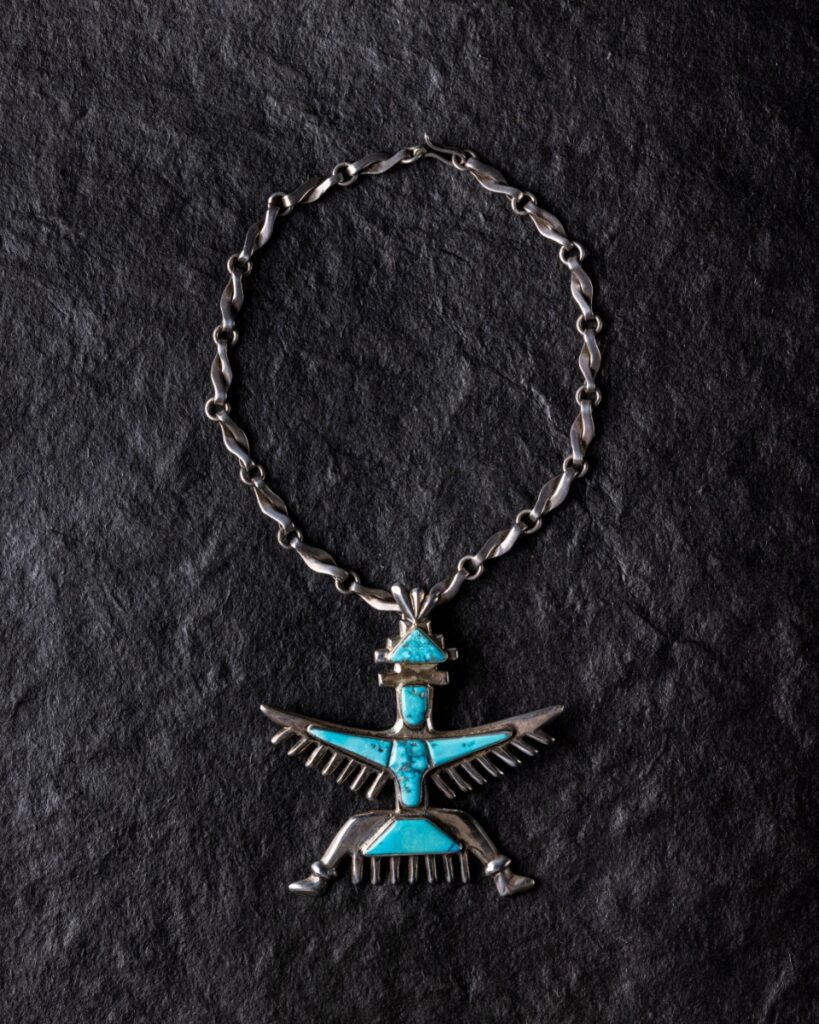
Above: Juan de Dios (Zuni, 1882–1940s), Knifewing pendant, 1930s–1940s, Silver and turquoise, 10 x 3 ½ x ½ in., Wheelwright Museum, Gift of James and Lauris Phillips
Juan de Dios was one of the first Zuni smiths to cast silver using carved volcanic tuff, and to cast Knifewing birds. De Dios was also one of the first to use a hallmark, stamping his initials “JD” into his work as early as the 1920s. Each family of jewelers has a different way of creating Knifewings. Juan de Dios’ version is visually exciting, achieved by casting pendant wing and tail feathers into the design—creating movement—and ornamenting his body with turquoise.
The Knifewing is a human-bird deity who figures prominently in Zuni oral history; he is the emblem of the Bow Priest Society. The Knifewing also formed the central motif of the Fred Harvey Company’s Indian Building sign at Albuquerque’s Alvarado Hotel and appeared on trader C.G. Wallace’s Gallup store stationery in the 1940s. Both companies helped promote the use of the Knifewing motif in Zuni jewelry.
Lambert Homer
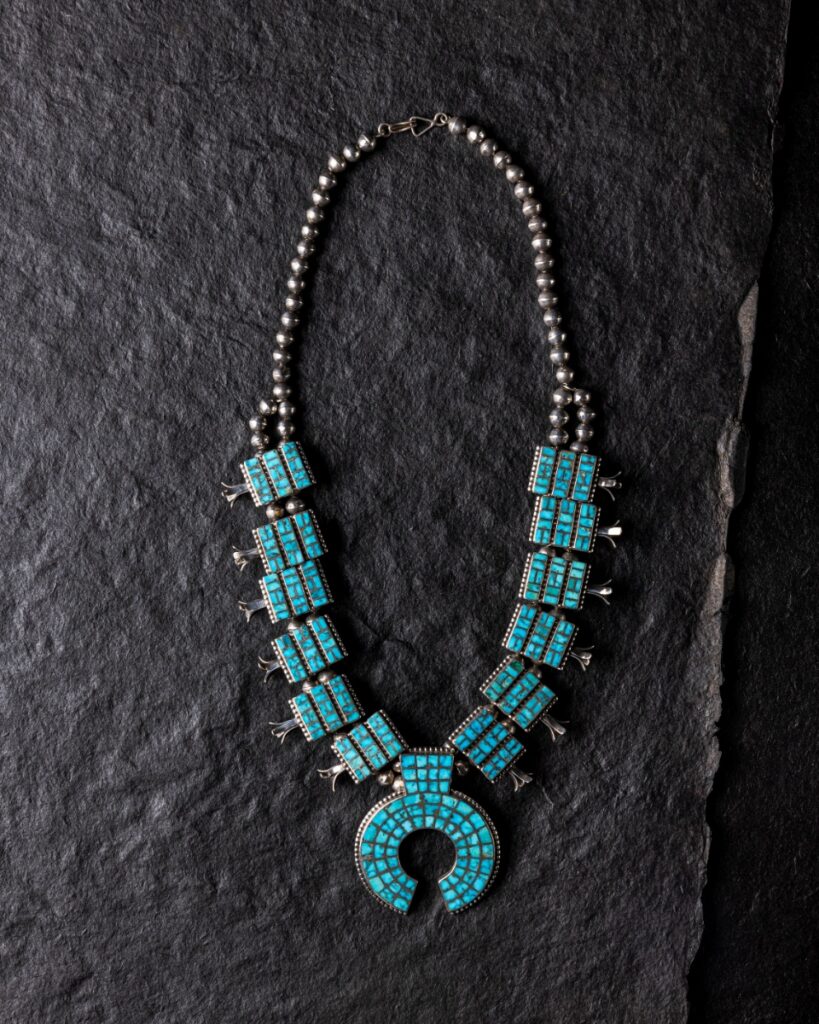
Above: Attributed to Lambert Homer (Zuni, 1917–1972), Squash blossom necklace, ca. 1950–1960, Silver and Blue Gem turquoise, 13 ¼ x 2 ½ x 3/8 in., Wheelwright Museum, Gift of James and Lauris Phillips
By the mid-to-late 1920s a few Zuni jewelers began experimenting with channel inlay, forming small compartments of silver into which expertly carved stone and shell were fitted, resulting in elaborate geometric patterns. Lambert Homer may have created the lapidary work for this necklace, but the silverwork was likely completed by a Navajo smith. Fabian Homer, Lambert Homer’s grandson, recalls that he had more than a dozen different patterns to work with. As in many Zuni households, Homer’s jewelry designs have been passed down through the generations.
Edith Tsabetsaye
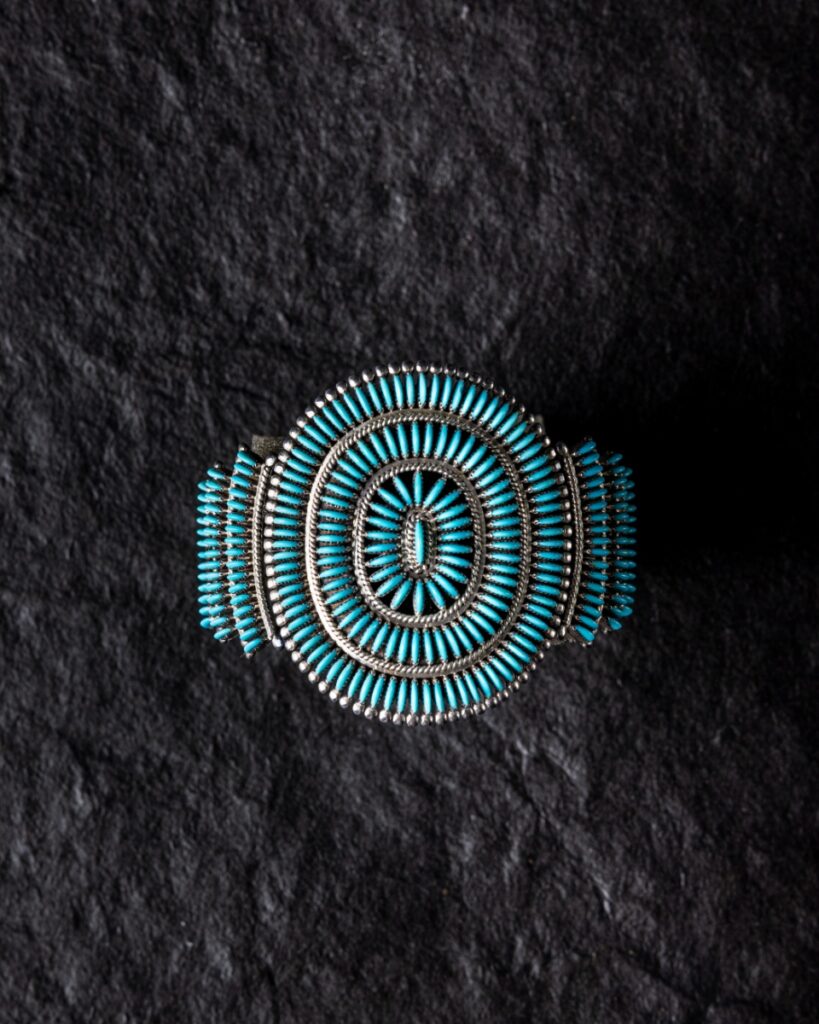
Above: Edith Tsabetsaye (Zuni, b. 1940), Bracelet, 1990–2001, Silver and Sleeping Beauty turquoise, 2 5/8 x 2 1/4 x 2 in., Wheelwright Museum, Estate of Sidney and Ruth Schultz
Since the 1950s Edith Tsabetsaye has reigned as master of the needlepoint style. Using finely shaped, double-pointed slivers of clear Sleeping Beauty turquoise for this bracelet, she created radiating rows that remind one of a flower blossom. Appropriately, it won first prize blue ribbons at the 69th annual SWAIA Santa Fe Indian Market and the Gallup Inter-Tribal Indian Ceremonial in 1990.
Tsabetsaye was also one of the first Zuni silversmiths to work in gold. She often set her pieces with deep blue Lone Mountain turquoise or bright red Mediterranean coral. Some turquoise in her needlepoint patterns, such as this bracelet, are domed and rise high above their surrounding bezels. Each carefully matched crescent-shaped stone is visible from both sides. Other stones are cut with curves and angles, creating a wavy effect that carries across the design.
The channels of this necklace are set with beautiful Blue Gem turquoise, creating the arc-shaped central naja. The naja is an element adapted from Spanish horse bridles. Here, the typically rounded “squash blossom” elements are flattened into rows of squares and rectangles. Silver raindrops separate these shapes, which may represent stone masonry, gridded Zuni waffle gardens, or stacks of blue corn.
Owen Bobelu
Above: Attributed to Lambert Homer (Zuni, 1917–1972), Squash blossom necklace, ca. 1950–1960, Silver and Blue Gem turquoise, 13 ¼ x 2 ½ x 3/8 in., Wheelwright Museum, Gift of James and Lauris Phillips
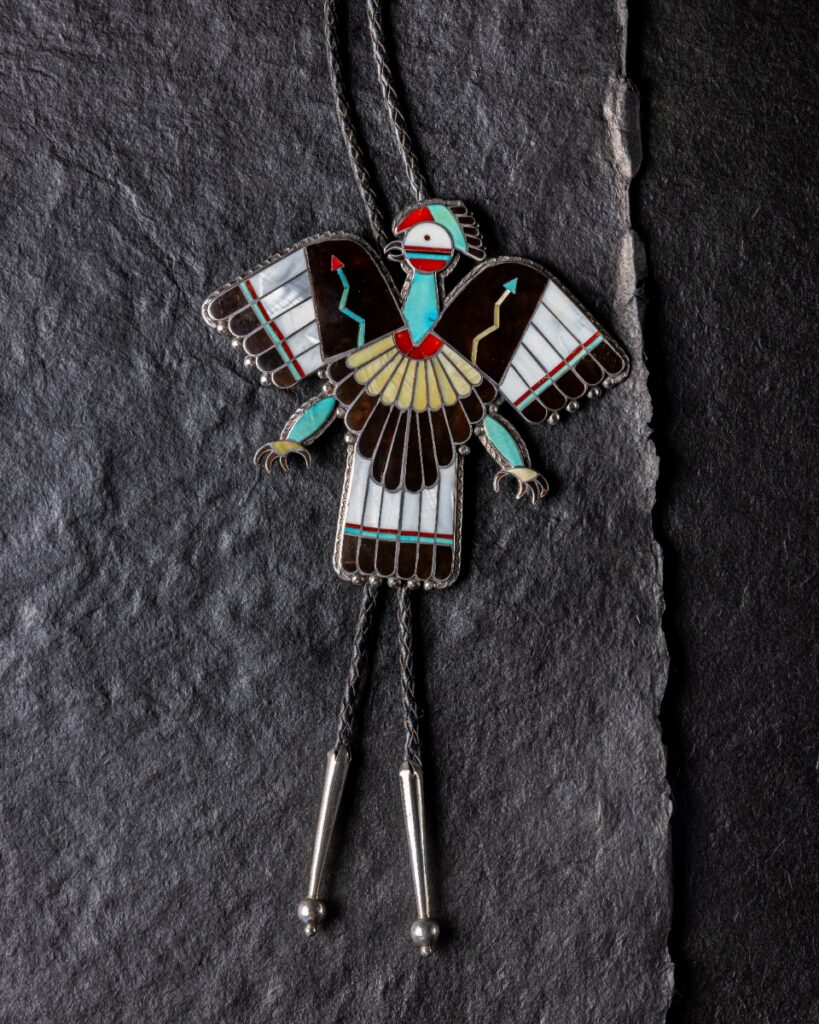
Owen Bobelu is a talented maker of channel inlay jewelry representing human and animal figures. His bolo tie ornament features a thunderbird, a common motif that originated with tribes from the Plains and Northeast. Adopted as a design motif by many Native cultures, thunderbirds are thought to be protectors against evil.
Bobelu used shimmering mother-of-pearl and yellow lip oyster shell to create the outstretched wing and tail feathers. Alluding to the thunderbird’s home amongst storm clouds, lightning flashes from his wings.
Leekya
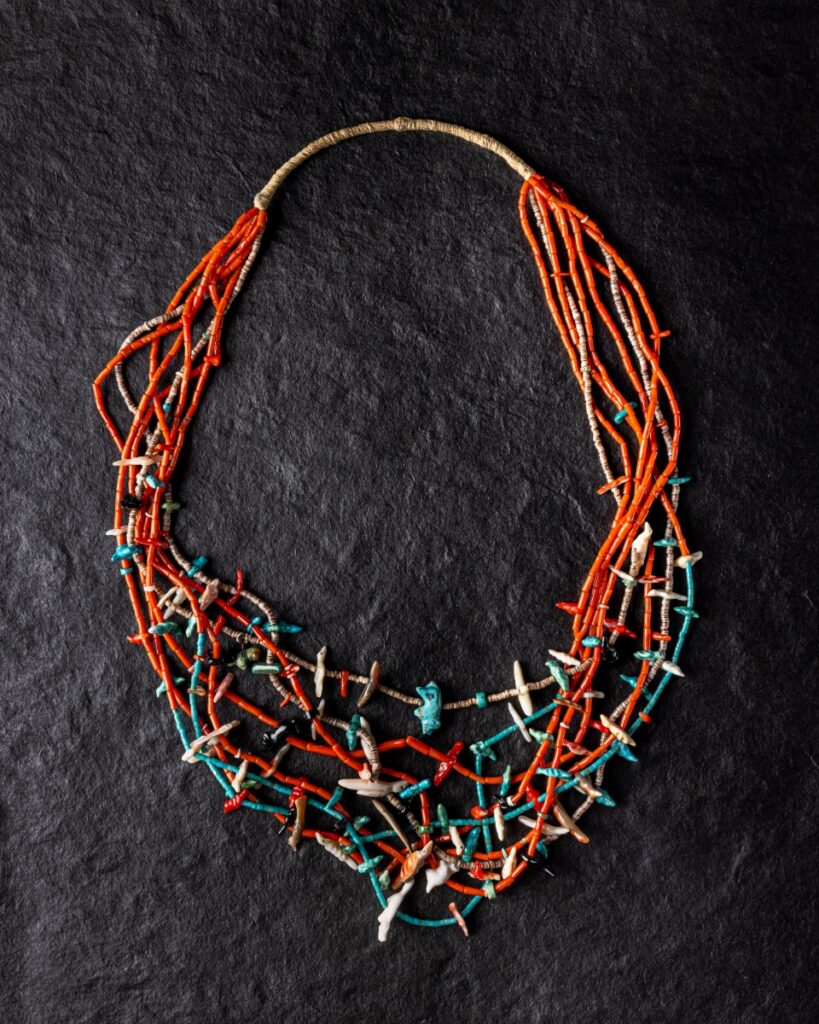
Above: Leekya (Zuni, 1898–1966), Fetish necklace, 1928, Red coral, turquoise, jet, white shell, heishi, pink coral, and cotton cordage, 17 x 4 ½ x 1 in., Wheelwright Museum, Gift of Carole Katz
Leekya’s 8-strand, 121-fetish necklace of birds and bears is a masterful example of what the artist was able to create from impossibly small fragments of stone, coral, and shell. It is one of the earliest documented “fetish necklaces” to have been purchased from Leekya by trader C.G. Wallace, with fetishes made during Wallace’s first year of operation. Part of a group of carvers who made stone and shell fetishes for ceremonial and personal purposes, Leekya was one of the first to begin making commercial carvings incorporated into jewelry designed specifically for the tourist market.
Leekya believed that animals should look happy. His bears and wolves often gaze open-mouthed with tongues extended, while birds twist their heads sideways in quizzical disbelief. Leekya’s carvings are famous for their softly undulating, hand-filed surfaces that delineate the animals’ ears, toes, feathers, wings, and tails.
Walter Nakatewa
Walter Nakatewa was born at a time of profound change within the world of Zuni jewelry, making inlaid dance shells in the early 1900s, then commercial mosaic and channel inlay pieces by the mid-century. In addition to making jewelry, Nakatewa worked on the field crew for F.W. Hodge’s 1920s excavation of the ancestral site of Hawikku, clerked at C.G. Wallace’s trading post in the 1930s, and even joined the National Guard.
Walter Nakatewa’s Shulawitsi represents the Little Fire God, who ensures rain, health, and prosperity to the A:shiwi people. The colorful dots on his body represent fire, seeds, and stars. He carries a bag of seeds in one hand and firebrands in the other as he lights the ceremonial fires signaling the beginning of the annual Shalako ceremony.
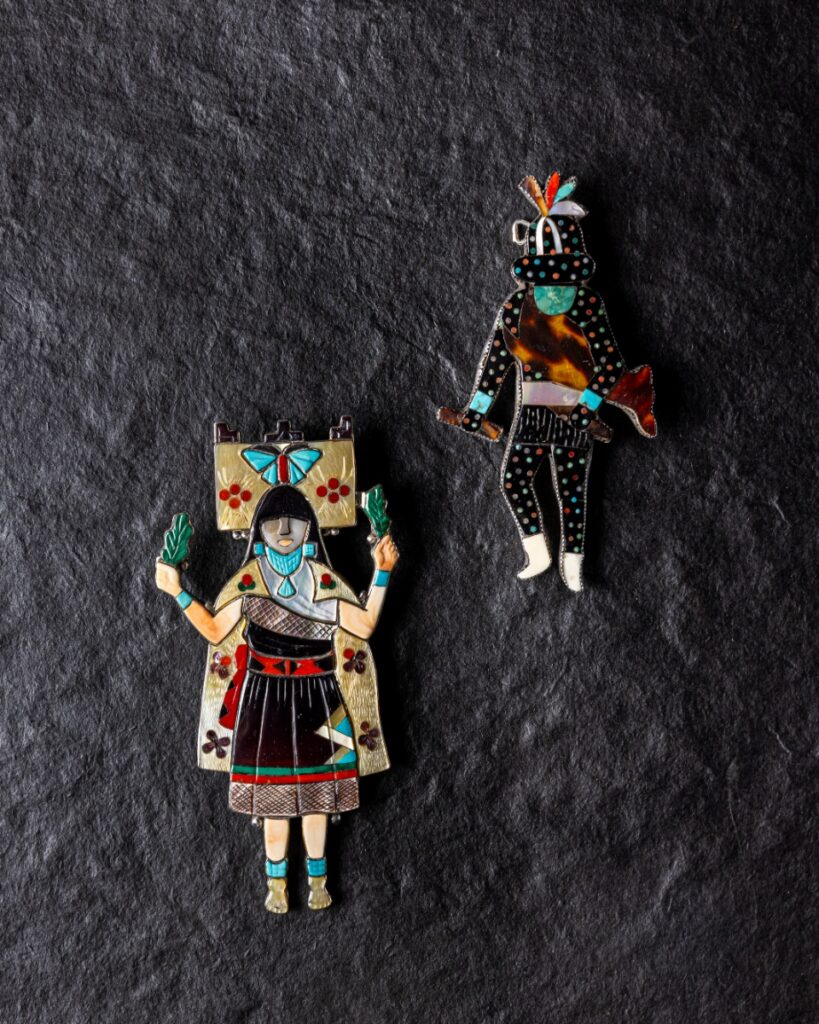
Above: (right) Walter Nakatewa (Zuni, ca. 1910–?), Brooch, 1940s–50s, Silver, jet, tortoise shell, coral, turquoise, abalone, white shell, pink and white mother-of-pearl, 5 ¼ x 2 5/8 x ½ in., Wheelwright Museum, Gift of the Estate of Ruth and Sidney Schultz, (left) Polik Mana, Virgil Benn, (Paiute/Zuni, b. 1930s) and Shirley Benn (Hopi/Tewa, b. 1936, active 1950–80), Bolo ornament/pendant, 1960s–80s, Silver, yellow lip oyster, melon shell, jet, abalone, turquoise, and coral, 6 x 2 ¼ x ½ in., Wheelwright Museum, Gift of the Estate of Ruth and Sidney Schultz
Virgil and Shirley Benn
Virgil and Shirley Benn are contemporary masters of channel and mosaic inlay. They are the first jewelers at Zuni to use etching in their work along with delicate hand carving, creating beautifully carved and textured surfaces. Shirley Benn is also a maker of pottery, having descended from a long line of famous Hopi potters including Nampeyo of Hano, Daisy Hooee, and Annie Healing. From this background she draws from Hopi culture for inspiration.
Polik Mana
Polik Mana is a beloved Butterfly Maiden, a dancer who symbolizes beauty and fertility. She is celebrated for her role in pollinating fields and flowers and bringing rain. In the Benns’ bolo ornament, Polik Mana wears a shimmering butterfly headdress along with a beautifully carved shawl, dress, and under-dress.
Story by Deborah C. Slaney
Photos by Tira Howard
Subscribe to TABLE Magazine‘s print edition.