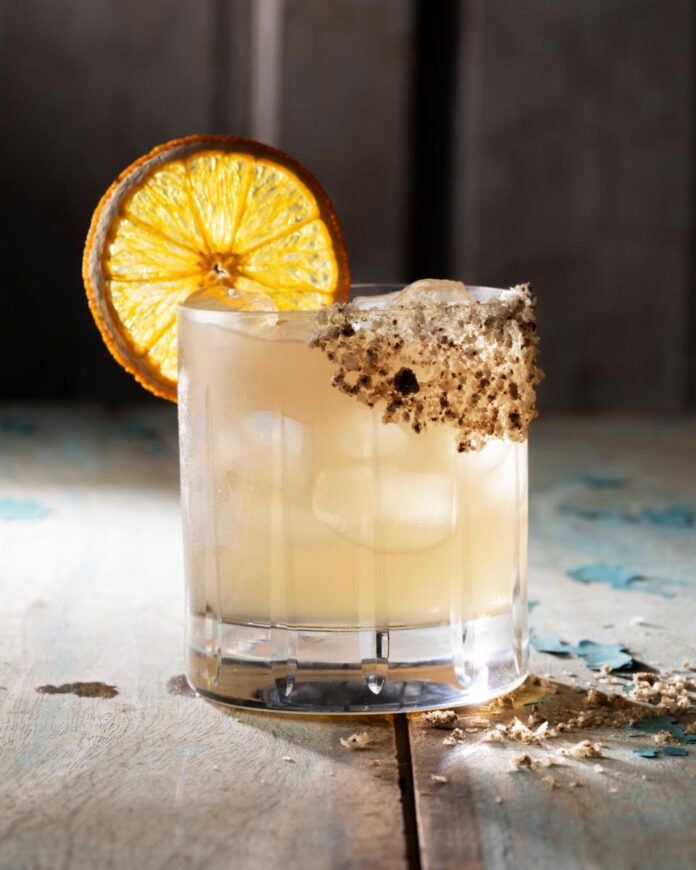
The Greyhound 75 is a fun play on the classic French 75, which originated in Paris in the 19th century and became popular in the Roaring 20s.
While the older version combines champagne, gin, lemon, and sugar, we might be thirsty for the intriguing tang of pamplemousse. That’s French for grapefruit, and it’s fun to say. Because le pamplemousse brings a bit more sweetness than the usual lemon, we cut back on the sugar here. Salut!
Why is this Cocktail Called the Greyhound 75?
The “75” comes from the French 75, which apocryphally got its name from a 75mm World War I bullet. But this cocktail mixes the ingredients of the French 75 with the “Greyhound” cocktail. The Greyhound consists grapefruit juice and gin or vodka, mixed and served over ice. So, this bubbly version of the cocktail comes into being with grapefruit juice, prosecco, gin, and simple syrup.
Combine grapefruit juice, simple syrup, gin and ice in a cocktail shaker and shake for about 30 seconds until cold. Strain into champagne flute and top with champagne or sparkling wine.
New York-based mixologist Brian Miller riffs on the gin-based 20th Century by using bourbon instead of gin and Lillet Rouge instead of Lillet Blanc. This ruby toned cocktail is a bourbon-gem.
What Makes This Cocktail 19th Century?
Use of the term “bourbon” as a specific type of whiskey began to gain recognition in the 19th century. While it was likely being produced in the late 18th century, it wasn’t until the 1800s that bourbon became associated with a specific style of whiskey, particularly in Kentucky. Gin overtook bourbon by the time the roaring ’20s came around, but for a time, it represented American drinking culture, particularly in the South and West. It became a drink of choice because of its growing availability and popularity. But you can still toast to the past with this 19th century cocktail.
A well-loved Haitian family dish prepared in a Creole court-bouillon-style sauce, poisson gros sel is a show-stopping alternative to the traditional Friday fish fry. Thanks to Chef Claudy Pierre for sharing this delicious recipe with TABLE Magazine.
What Does Poisson Gros Sel Mean?
Since this is a dish for the Lenten season, it’s fish, the traditional Friday food. But the literal translation of the name is “fish with big salt.” However, this fish is not actually very salty, and you’ll notice the ingredient list barely features salt at all. The “big salt” is rock salt, common on island beaches. You only need a tablespoon of it, because it goes far. Plus, this dish gets many of its aromatic flavors from the court-bouillon broth it cooks in. For another Haitian recipe, try our Haitian Pork Griot.
For the fish, remove fish scales and clean with lime. Score the fish diagonally 3 times on both sides. Blend the next 8 ingredients into a paste and add it to the fish. Refrigerate and marinate overnight.
The next day, heat oil on low and cook snapper 5 to 7 minutes per side and set aside.
To a medium saucepan add liquid from marinated fish and excess marinade from the bowl. Pour fish broth or stock into the bowl to get the rest of the marinade and pour that into the pan as well. Sauté garlic and onions until soft then set aside.
For the sauce, add tomato paste, Scotch bonnet peppers, thyme, bell peppers, oil, and butter. Mix, cover, and cook for about 15 minutes on a medium to low flame.
After 15 minutes, spoon sauce all over and inside the fish. Add cloves, sautéed garlic and onions, mix and then cover for another 5 minutes. Serve over rice with a squeeze of lime.
Recipe by Claudy Pierre Styling by Rafe Vencio Photography by Dave Bryce
Every Haitian home has a jar or two of pikliz, a spicy pickled slaw, in the fridge. It’s great as a garnish, particularly with grilled meats, gifting your plate with a wake up kick to the tastebuds. Chef Claudy Pierre’s version is phenomenal with any meat during any season of the year.
Where Does The Name Pikliz Come From?
Pikliz gets its name from piquer, a French word that means “to sting,” alluding to its kick of spice and bitterness from the fermentation. The taste of Haitian Pikliz is similar to kimchi or other fermented cabbages, and you can serve it as a side dish with Haitian Pork Griot.
Combine the shredded cabbage, grated carrot, 1 sliced bell pepper, 1 sliced onion, 3 sliced scallions, 1 sliced shallot, and 2 sliced Scotch bonnets in a large bowl. Add the salt and freshly cracked black pepper.
Put on gloves, and thoroughly mix using your hands. Pack down the pikliz into sterilized mason jars. Cover with the white wine vinegar. Put on the lid and store in the refrigerator for at least 12 hours to marinate.
Recipe by Claudy Pierre Photography by Jacqueline Moss
When you think of cremas think “creamy,” “family,” “laughs,” “spices,” and “alcohol.” This Haitian version of egg nog or coquito is rich and delightful, and easy to make, often shared with family and friends during the holiday season. However, you can make it for any special occasion
The History of Haitian Cremas
Cremas most likely emerged around Haitian independence in 1804, though no one person is named as its original inventor. There’s a particular style of rum popular in Haiti, clairin, that’s best for cremas. Clairin uses local cane sugar in its distillation process, mixing well with the citrus and spices in cremas. Some say the secret to cremas is lime juice and lemon juice to thicken it and balance out the flavors. Cremas joins the pantheon of celebratory drinksfrom around the world like coquito, eggnog, and mulled wine as something to bring heart and spirit to the holidays.
Add the milks and cream of coconut in a large bowl then mix thoroughly. Add vanilla, almond, and star anise extracts, then cinnamon and nutmeg to the mixture. Add the limejuice. Add the dark rum and mix thoroughly.
Allow cremas to sit for 2 to 3 minutes and then use a funnel to pour the mixture into bottles. Now it’s ready to serve at room temperature or chilled – drink up!
Recipe by Claudy Pierre Photography by Jacqueline Moss
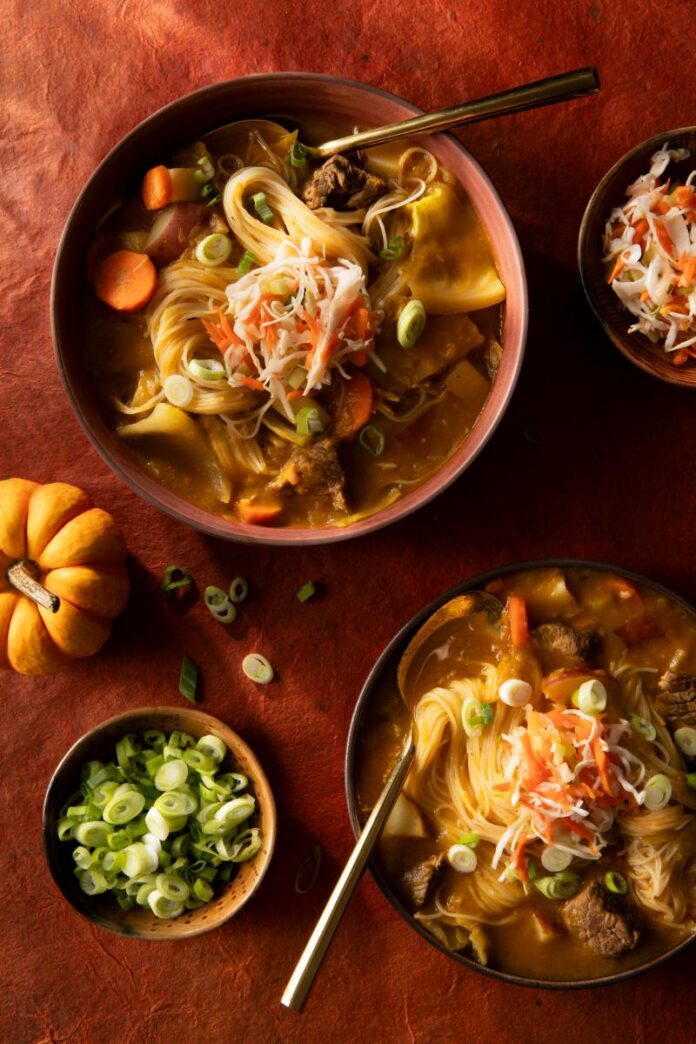
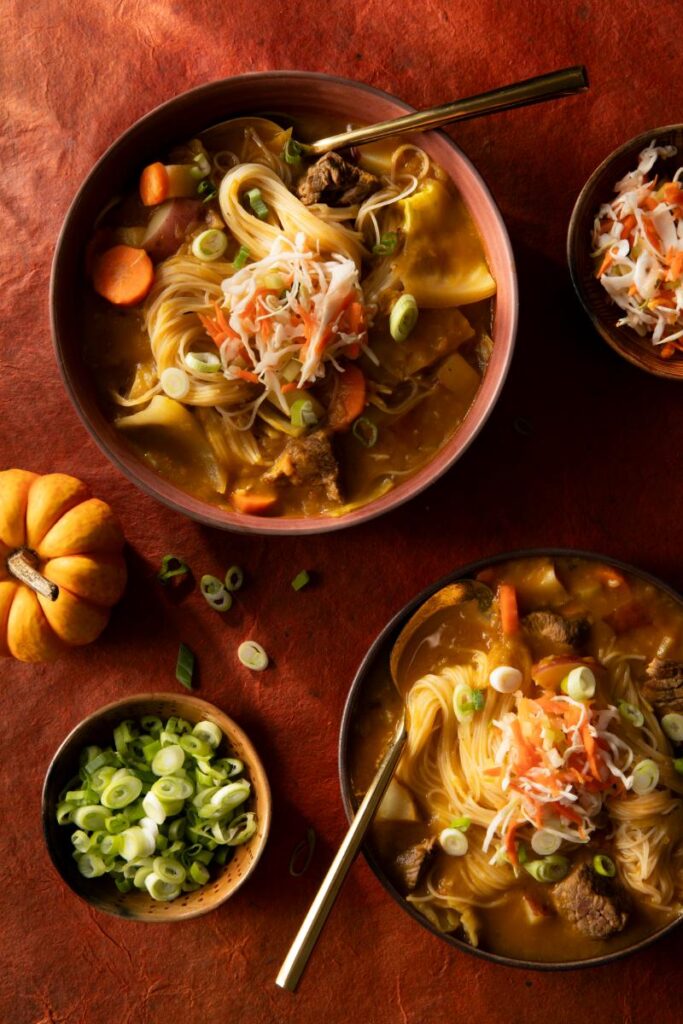
Soupe Joumou is Haiti’s most popular and symbolic soup. The resilient people of Haiti decided to celebrate its independence by eating the soup French deemed “upper class” the very minute Jean-Jacques Dessaline abolished slavery and declared Haiti independent from its French rulers. The preparation of Soupe Joumou begins with simmering beef, squash, and a medley of fresh vegetables such as carrots, celery, and onions. The result is a comforting, savory broth that’s both nourishing and satisfying. Traditionally, it’s served with pasta, potatoes, and sometimes even dumplings, adding texture and substance to the dish. The flavors of garlic, thyme, and Scotch bonnet peppers enhance the taste, making each spoonful a true taste of Haiti. Sip slowly and savor the flavors that are brought to us by Chef Claudy Pierre.
About Soupe Joumou
Beyond its culinary excellence, Soupe Joumou holds immense cultural and historical significance. It was once a dish reserved for the French colonizers, but after the Haitian Revolution, the newly freed Haitian people adopted it as a symbol of their independence and resilience. The soup represents freedom, strength, and the triumph of Haitian culture over adversity. Whether you’re preparing it for a holiday gathering or just craving a bowl of comforting soup, Soupe Joumou brings people together. This flavorful Haitian classic has earned its place as a symbol of pride and celebration. Make sure to try this rich, flavorful soup, and experience a taste of Haitian heritage in every bite.
Marinate the stew meat overnight in epis seasoning base.
Season butternut squash and pumpkin in salt, pepper, and olive oil, and roast for 45 minutes at 300 degrees.
Puree the squash and pumpkin in vegetable stock.
In a stockpot, add more oil, tomato paste, and meat and brown on all sides until caramelized. Cover and continue cooking 20 minutes over medium heat.
Next, add 3 cups of water and the pureed squash and pumpkin; bring to a boil.
Add the vegetables, tomato sauce, parsley, and top with the Scotch bonnet pepper, bring to a boil then simmer for 1 hour. (Don’t forget to remove the whole Scotch bonnet before continuing the recipe.) Now add the pasta and cook until soft.
Serve with toasted Haitian bread and share with close family and friends.
Haitian Pork Griot is a fun family favorite that you find at most gatherings with other delicious fried fritay (finger food) assortments such as plantain, banan péze, goat, or beef. Pork griot is typically deep-fried, but can be broiled for a still-charred, less messy, and always tasty meal. For the non-pork eaters, follow the same routine with goat or turkey. Chef Claudy Pierre’s delectable vision here ensures that not a nite will be left at the end of your party.
History of Haitian Pork Griot
Sometimes you’ll see griot spelled as griyo, but no matter how you spell it, it’s the same delicious dish. A griot is also a name for a traveling poet or storyteller in West African traditions, which is a fitting name for this dish that is a Haitian family tradition. The origins of griot go back to the African diaspora, where enslaved Africans brought their culinary traditions to Haiti. The name “griot” comes from the French word “grillage,” meaning “grilled” or “roasted,” referencing the preparation method used to cook the pork. As Haiti fought for independence, griot became a symbol of the country’s resistance and cultural resilience.

Quarter and chop the chiles then add epis, onion, bell pepper, parsley, salt, pepper, thyme, and garlic into a heavy pot with a lid. Mix in vinegar, juices, and Worcestershire sauce. Add the pork. Cover pot and refrigerate overnight.
The next day, remove from the fridge at least no more than 3 hours before cooking. Preheat oven to 325 degrees. On stovetop, heat on high and bring to a simmer then cover and transfer to the oven. Cook, stirring occasionally, until meat is very tender, about 1 1/2 to 2 hours.
Remove meat from the pot with slotted spoon, allowing excess liquid to drip back into the pot. Pick any veggies and herbs off the meat, and then transfer meat to a baking sheet. Drizzle meat with 2 tablespoons oil and a pinch of salt and toss to coat. To make a sauce, strain cooking liquid through a mesh sieve to remove solids. Return sauce to pot and simmer over high heat until reduced by half, 25 to 30 minutes.
I love to deep-fry the griot, but it gets pretty messy, so here is the broil method:
Fire-up the broiler and then add the meat, tossing occasionally until meat is evenly browned, about 5 to 10 minutes. To serve, drizzle pork with oil, crown with sauce, and garnish with parsley and thyme. Serve with rice and a side of pikliz.
For the epis:
Blend all ingredients in a blender or food processor. Store in mason jars and refrigerate. Great for marinating and adding life to any savory dish, and also can be used as a dipping sauce.
Recipe by Claudy Pierre Styling by Rafe Vencio Photography by Dave Bryce
Chef Curtis Gamble invited TABLE Magazine to spend a day in his kitchen with simple recipes and springtime flavors. He had our full attention with this first delicate and delicious plate. “I look for ways to be reductive,” Curtis says, explaning his keep it simple ethos. “Limiting myself to a certain ingredient or idea leads to creativity with texture, salt, fat, and acid. Allowing space and room for flavor to breath is a skill.” In a dish like Gnocchi alla Romana with Pesto Genovese, it would be easy for the heaviness of pasta to overtake the dish. We will never forget these gnocchi, with their earthy crispiness playing off of the vivid, garlicky sauce, or any of Chef Gamble’s veggie-forward dishes.
What Makes This Gnocchi “alla Romana”?
There are many different kinds of gnocchi, depending on the grain. What makes this gnocchi Roman-style is that it uses semolina, milk, and cheese, giving it a uniquely filling texture and flavor. However, Curtis paired it with a Northern Italian condiment, the classic Pesto Genovese recipe from the city of Genoa. That results in the combination dish of Gnocchi alla Romana with Pesto Genovese.
Bring milk, salt, and pepper to a high simmer, almost to a boil. Using a hand-held sifter, sift in semolina and whisk while doing so.
This prevents clumping and promotes even cooking of the semolina. Once all is incorporated, continue to cook briefly until starch is cooked through (it will begin to pull away from the pot and won’t be starchy in the mouth).
Turn off heat, beat in 1 egg at a time, fold in cheese at the end. Pour into an 8 x 8 baking dish sprayed with nonstick spray and press into an even layer. Cool in the refrigerator. When cool, cut it into inch by inch squares.
For the pesto:
Combine all ingredients in a food processor.
Pulse to combine.
To finish:
Warm a pot of oil to 350 degrees and fry gnocchi until they are golden brown, and then lift with a slotted strainer onto some paper towels to dry, adding salt and pepper.
In a bowl, add 2 tablespoons pesto and toss gnocchi, salt, extra parm, and a touch of EVOO. Serve immediately.
Recipe by Chef Curtis Gamble Styling by Keith Recker Photography by Dave Bryce
This Bigoli in Salsa dish is a combination of sweetness and saltiness. It is typically served in northern Italy on fasting days such as Christmas Eve, Ash Wednesday, and Good Friday, but you can find it year-round in local osterie and restaurants. Sara is a Venetian, and her cooking exemplifies the city’s beauty and mystique. It’s truly La Serenissima.
What Are Bigoli?
Bigoli (or bigoi in the dialect of the Veneto) are thick, spaghetti-like pasta typical of the Veneto and eastern Lombardy. They are available fresh or dried, whole wheat or white. Common sauces for this type of pasta in the Veneto region are duck ragùa, or humble yet flavor-filled salsa of sardines (or anchovies) and onions. This Bigoli in Salsa is a must-try for any Italian food aficionados looking to expand from ordinary spaghetti and tomato sauce. Also try Sara’s Sarde in Saor for another Venetian classic.
Cut onions in half and slice them really thin. Bring a large pot of water to boil with 1 cup white wine, blanch onions for 1 minute, drain and set aside.
Heat olive oil in a large pan, add whole peeled garlic cloves, and cook for 2 minutes. Take them away and add onions. Cook at low-medium heat for about 20 minutes, stirring constantly. Onions should become translucent, be careful not to let them brown, and add a bit of water if needed.
If using salt-packed sardines, soak them in a bowl filled with cold water for a few minutes. Drain them on paper towels, split in half and remove their spines, tails, guts, and bones. If using anchovies, drain oil completely. Cut in small pieces.
Meanwhile, bring another large pot of water to boil, add salt as needed, and cook bigoli al dente, following package instructions. Add sardines (or anchovies) to the onion, pour in the rest of the wine, and let it evaporate completely cooking at medium-high heat. Drain bigoli and sauté in the pan with the onions and sardines for 1 minute. Taste and add salt only if needed. Season with black pepper and few leaves of fresh parsley. Serve immediately.
During a recent visit to her Italian hometown, TABLE Magazine contributor Sara Ghedina spent some time in the kitchen. She brought back dishes like this Sarde in Saor. In the dialect of Venice, saor means “taste,” as in savor, so it translates to “sardines in taste.” It lives up to its name, given how flavorful the end result is. The term indicates specific seasoning – based on vinegar, onions and other sweet and sour elements – that the fishermen invented to preserve their fish, in the absence of refrigerators. It is an ancient practice in Venetian cuisine, which people now use for shellfish and vegetables as well.
What is Sarde in Saor?
Sarde in saor is a deeply traditional recipe for marinated sardines from Italy’s Veneto region. It’s traditionally for the Festa del Redentore in the middle of July (one of the most popular Venice festivals, with magnificent fireworks that are reflected in Saint Mark’s Basin), but you can find them year-round in local restaurants and wine bars. For a full Venetian experience, serve this characteristic appetizer with a glass of chilled Pinot Grigio or Prosecco. Even if you’re just cooking at home, indulge in a taste of Venice.

2 lb whole sardines, gutted, scaled, and heads removed
1 cup flour
Sunflower oil, for frying
4 to 5 tbsp extra-virgin olive oil
3 lb yellow onions, thinly sliced
4 bay leaves
1 cup white wine vinegar
3/4 cup raisins
1/4 cup pine nuts
Salt and pepper, to taste
Instructions
Rinse the sardines under cold water and pat them dry with paper towel. Place flour in a large bowl, add the sardines, and toss to dust evenly. Shake off any excess.
Heat sunflower oil in a medium frying pan, and fry the sardines in batches, a few minutes on each side, until they are crisp on the outside. Drain and transfer to a plate covered with paper towel. Season with salt and repeat with the remaining sardines, working in batche
Meanwhile, heat olive oil in a large saucepan, add onions, bay leaves and vinegar, season with salt and pepper, cover the pan and cook at low heat stirring often, until onions are soft and translucent, about 40 to 45 minutes.
Arrange a thin layer of onion in a large glass bowl. Sprinkle with some raisins and pine nuts and cover with a layer of sardines. Repeat in layers until you have used all the ingredients, finishing with a layer of onions, raisins and pine nuts. Pour on top any cooking liquid that is left from the onion.

Let cool down, then cover with plastic and place in the refrigerator to marinate for at least 24 hours, but even better for 48 hours or longer.
Serve them as an appetizer with a slice of grilled polenta. Keep marinated sardines in the refrigerator but remember to take them out a few hours before serving, as they should be eaten at room temperature.