The Castellanos family lived in Mexico City in the 16th century and observed Passover more than other Jewish holidays. Christian Holy Week and Passover usually fall close to one another, so the crypto-Jewish traditions of the Americas reflect a mix between Jewish practices and Christian ones. Back in Portugal, the Castellanos would have used chard but in the new world, substituted lettuce instead. The Castellanos ate this Lamb and Lettuce Stew with unsalted and unleavened bread.
Nowadays, we can still point to crypto-Jewish traditions that have endured through the centuries. In The International Review of Jewish Genealogy by Burqueño Edwin Berry explains that he “recalls his mother making what he says resembled unleavened bread once a year around Lent. It was like a long biscuit, and it was eaten only a few days of the year.” (See Secrecy and Deceit, by D. Gitlitz). This is an echo of the habits of the Castellanos and other crypto-Jewish families of the Spanish colonial era.
Eating lamb at Passover was also a custom among crypto-Jews in Mexico, as Salomón de Machorro (aka Juan de Leon) told Inquisitors in 1642.
Print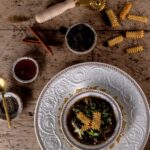
The Castellanos’ Lamb and Lettuce Stew with Unsalted Bread
Description
Warm up your soul and your stomach.
Ingredients
For the lamb:
- 1 lb boneless lamb, shoulder or leg, cut into 1-inch cubes
- 1 tsp ground ginger
- 1 tsp ground cumin
- ½ tsp ground cinnamon
- ¼ tsp cayenne pepper
- 2 tsp salt
- 2 tsp black pepper
- 2–3 tbsp olive oil
- 1 onion, finely chopped
- 2 garlic cloves, minced
- ½ cup chicken broth
- 1 head of lettuce (butter or green leaf), washed and chopped
- 1–2 tbsp honey
- ½ cup raisins
- 2 tbsp chopped fresh parsley, to garnish
- 2 tbsp chopped fresh cilantro, to garnish
- Matzah strips, to garnish
For the matzah:
- 1 cup white wheat flour
- 1½ cup masa harina
- ½ cup + 2 tbsp cold water
- Vegetable oil for frying
Instructions
For the lamb:
- In a large bowl, combine the cubed lamb, ginger, cumin, cinnamon, cayenne pepper, salt and black pepper.
- Place in a bowl, cover, and refrigerate.
- The next day, heat 2 tablespoons of olive oil in a large skillet over medium-high heat. Add the onions and garlic and sauté gently until golden brown. Remove the onion mixture and set aside
- Add the lamb mixture and cook, turning the pieces over, until all sides are browned, adding another tablespoon of olive oil if needed.
- Add back the onion mixture back and stir to combine with the lamb.
- Pour in the chicken broth and bring to a simmer. Cover the skillet and reduce the heat to low. Cook 3-4 hours until the lamb is almost tender. Add the lettuce, raisins, and stir in the honey and cook until the lamb is fully tender and falling apart and the lettuce is wilted. The sauce should be thickened. Taste and add more salt or honey as desired.
- Sprinkle with chopped parsley and cilantro. Serve hot with strips of matzah.
For the matzah:
- Prepare 2 sheets of plastic wrap that are a little bit larger than the tortilla press. They will be used for the tortilla press to avoid the dough sticking to the tortilla press sides. If you don’t have a tortilla press, you can roll out the dough between sheets of parchment paper.
- Mix the two flours. Progressively add the cold water to the flour and stir constantly until the flours absorbs all the water. Knead the dough for about 5 minutes. The dough should be moist to the touch.
- If using a tortilla press, cut the dough into 3 pieces and roll into balls the size of ping pong balls.
- Open the tortilla press, place a plastic sheet (or parchment paper) on the bottom, a ball of dough in the middle, and cover with the other plastic sheet. Close the tortilla press and press down to flatten the dough. Open the tortilla press and carefully remove the dough from the plastic wrap.
- Preheat your nonstick iron skillet to medium-high heat.
- Cut the dough into strips about ½ inch wide and lay the strips carefully onto the hot skillet coated with a small amount of oil. Fry the strips for about 15 seconds. Remove and place on a paper towel to drain.
Recipes appear in Jawhara-Piñer’s books, Matzah and Flour: Recipes from the History of the Sephardic Jews, and Sephardi: Cooking the History. Recipes of the Jews of Spain and the Diaspora, from the 13th Century to Today. To dig deeper into Jewish food history, read Jawhara-Piñer’s Jews, Food, and Spain: The Oldest Medieval Spanish Cookbook and the Sephardic Culinary Heritage.
Recipe and Story by Hélène Jawhara-Piñer
Food Styling and Preparation by Julia Platt Leonard
Photography by Gabriella Marks
Subscribe to TABLE Magazine’s print edition.