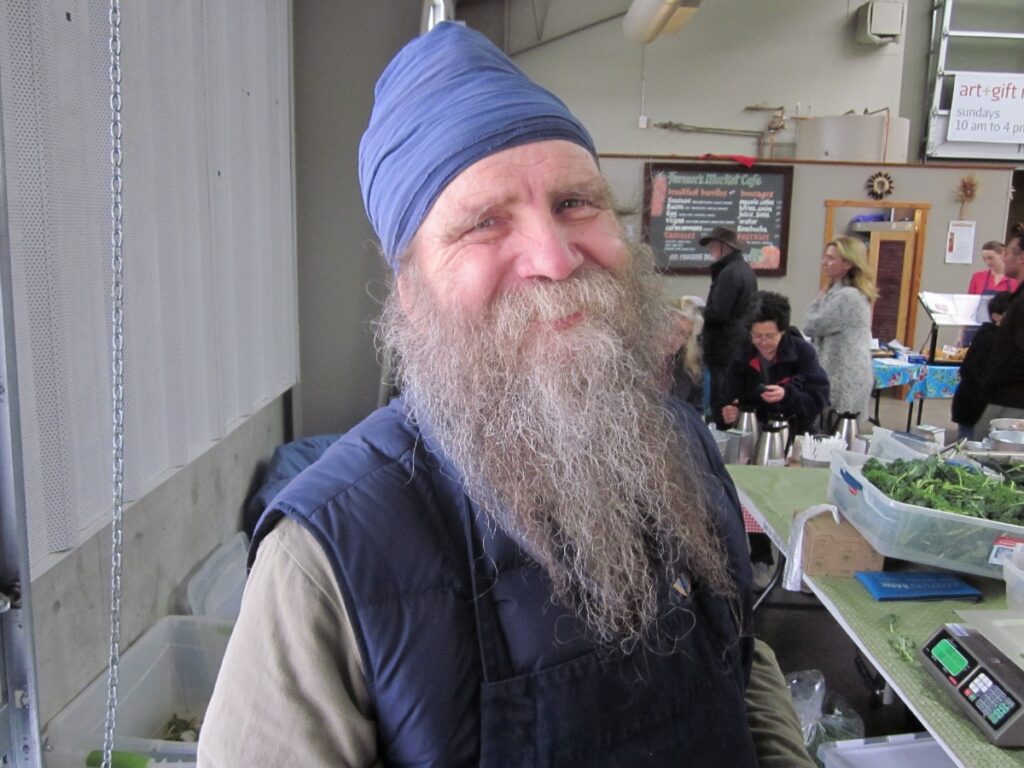
Every time you shop at the Santa Fe Farmers’ Market you support local farmers. It’s a decision that matters – we get the freshest and best quality food while helping Northern New Mexico farms stay healthy and strong. Bevin Carnes of the Santa Fe Farmers’ Market Institute introduces us to the folks at Khalsa Family Farms and tells us how they’re sharing their harvest with school, senior centers, and food banks plus teaching budding farmers how to work the soil in New Mexico.
Khalsa Family Farms: Sharing Their Harvest with the Community
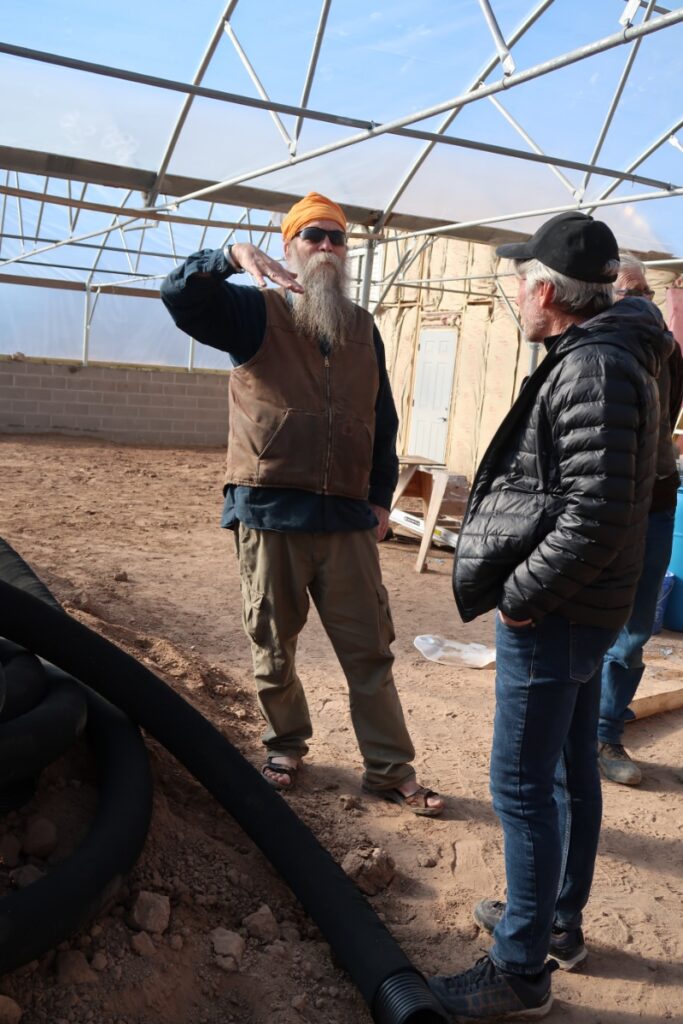
After retiring to New Mexico following a 35-year career as a builder in New York City, Sirivishnu Singh Khalsa found an unexpected use for his construction talents: building greenhouses. Though his new career was unplanned, the work is rooted in a centuries-old Sikh tradition of feeding people.
Today, Khalsa Family Farms is one of the largest vendors of greens at the Santa Fe Farmers’ Market during the winter, using innovative technology and sustainable practices to produce food year-round. Much of its harvest goes to schools, senior centers, and food banks, while its internship program helps train a new generation of farmers.
Feeding the Community Through Sikh Tradition
BC: The idea of providing food to your community seems to have deep meaning for you. Where does that come from?
Sirivishnu Singh Khalsa: We’re part of a Sikh community in Española, and for centuries, Sikhs have served food to people. Even today, the Golden Temple in northern India serves 100,000 people a day in a free kitchen.
About 15 years ago, our ashram community started a program called Food for Kids. A lot of kids in our area don’t have enough food on the weekends, so we provide bags of food to about 600 children each week at schools in the Española area.
Building a New Career in Farming
BC: How did you first become involved in farming?
SSK: I spent about 35 years in New York City working as a builder before retiring to Española in 2016.
A year later, people started asking, “Hey, can you build us a greenhouse?” And I said, “I can do that.” From that point on, I learned a tremendous amount about farming and feeding people in northern New Mexico.
I enjoyed building a lot, and people were grateful when you built something nice for them, but it’s totally different when you’re feeding people. It’s a lot more personal, let’s put it that way.
Growing Fresh Produce Through the Winter
BC: Growing fresh produce in the middle of winter isn’t easy in Northern New Mexico. How do you make it work?
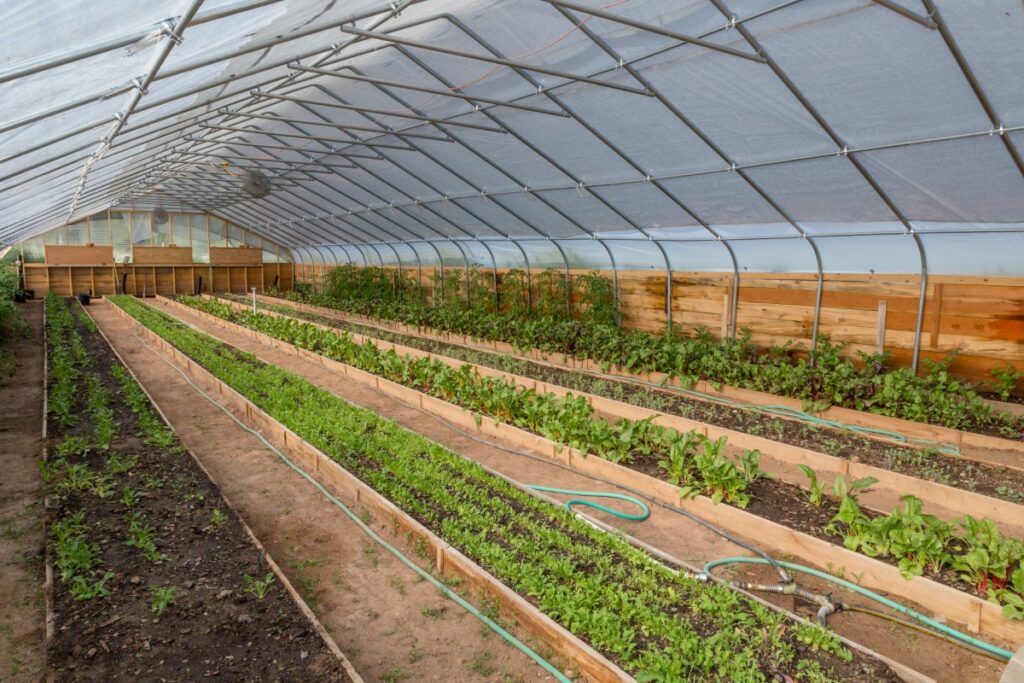
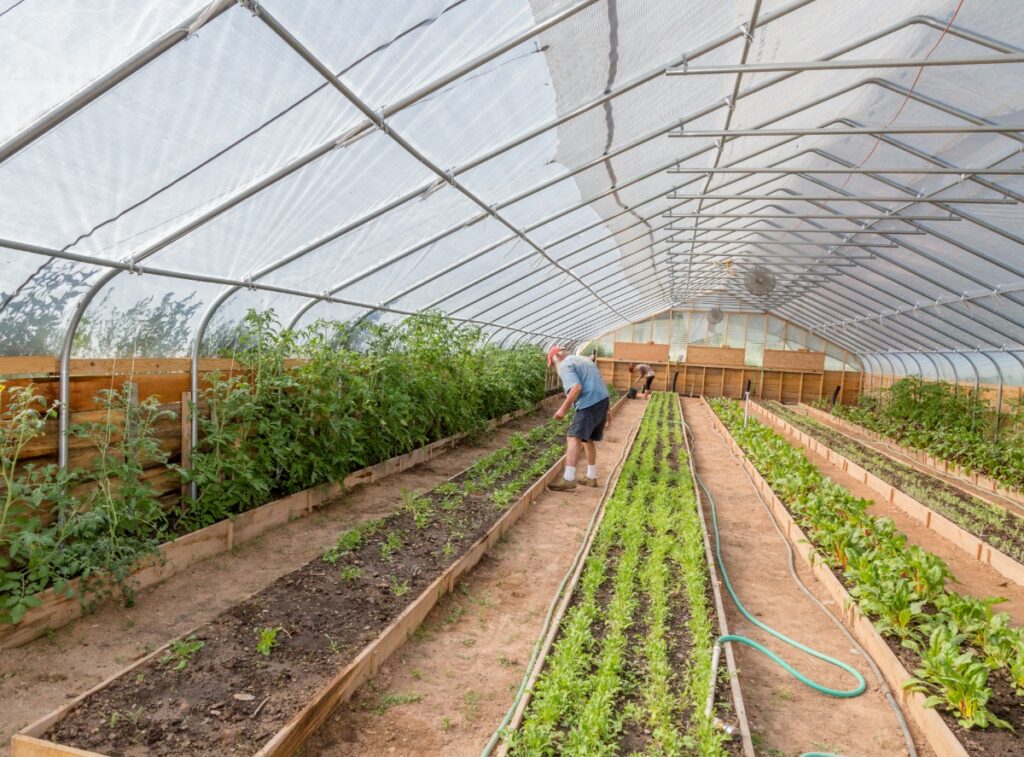
SSK: Our greenhouses let us control the climate. The climate battery [an underground system that exchanges and stores heat from the greenhouse air] keeps our greenhouse above freezing using only fans. So we’re not burning fossil fuels to heat it.
We obtained seven caterpillar tunnels [plastic-covered growing structures resembling giant caterpillars] from the USDA. We grow a variety of greens in them throughout the winter without any additional heating. And if you go to the Santa Fe Farmers’ Market on a Saturday morning in January, you’ll have to get into a long line for our greens.
Sustainable Farming and Experimentation
BC: Beyond the greenhouse technology, how important is experimentation to the way you grow food sustainably?
SSK: We have some amazing farmers running the show. Our farm manager, Shenoah Dalziel, came to us after graduating from UC Davis, and we’re blessed to have her leading the operation. Our senior farmer, Jim Fischer, is a real scientist when it comes to farming, and he spends a lot of time researching what’s out there.
We grow everything organically, even though we’re not certified organic. We’re Certified Naturally Grown. Pests are a challenge when you’re not using toxic chemicals. Plants and pests continue to evolve, so you have to keep track of what used to work but doesn’t anymore.
Jim experiments all the time with ways to keep the plants healthy and happy. Once, he said, “You know what? I’m just blasting the plants with water, and it’s knocking the aphids off. It’s working!” and I said, “Okay, let’s do that.”
Training the Next Generation of Farmers
BC: The farm also helps train young farmers. How does that fit into its larger mission?
SSK: We started a program called Seva Sadhana. Seva means selfless service, and Sadhana is a spiritual practice centered on meditation. People would come into the program and practice Seva by working on the farm.
I have a young man from San Felipe Pueblo who just started in our internship program in July. He’s 19, right out of high school, and he’s doing a great job and learning a lot. He’s handling our microgreen production now and helping with plant care.
It’s just really a blessing to be able to teach these young folks, and hopefully they’ll start running farms on their own in the future.
The Rewards of Feeding People
BC: What’s been most rewarding about becoming a farmer?
SSK: There’s so much goodwill in providing great food to people.
One day I delivered a bunch of these beautiful little yellow cherry tomatoes we grow to Growing Up New Mexico’s Early Learning Center in Santa Fe. There were about a hundred three- to five-year-olds eating lunch, and when I came in, [a staff member] said, “Hey guys, this is the gentleman that brings you all those cherry tomatoes.”
They all jumped up and said, “We love them! Thank you so much!” I mean, that can just turn your heart upside down and make it fly away.
All you need is a shot of that once a year and you’re good to go.
Read our last Faces of the Santa Fe Farmers’ Market profile on Santa Cruz Farm.
Story by Bevin Carnes
Photography by Gabriella Marks
Subscribe to TABLE Magazine‘s print edition.