The Native Artist Fellowships give artists a special chance to focus on their work while exploring amazing collections of pottery, jewelry, and textiles. At the School for Advanced Research, artists get to learn from history and let it inspire their own creativity. The Native Artist Fellowship is all about helping artists grow and connect with their culture in a meaningful way.
The School for Advanced Research’s Native Artist Fellowships Help Kickstart Creativity
Each year, three artists come to SAR — the School for Advanced Research — to take part in the SAR Native Artist Fellowship. For the artists, it’s a chance to immerse themselves in their art. It’s also an opportunity to access the Indian Arts Research Center (IARC), home to more than 12,000 pieces of pottery, jewelry, textiles, painting, basketry, and drums. We asked seven past fellows two questions — what is the piece from the IARC collection that’s influenced you the most and why?
Michael Namingha (Ohkay Owingeh/Hopi), 2023 Rollin and Mary Ella Kings Artist Fellow
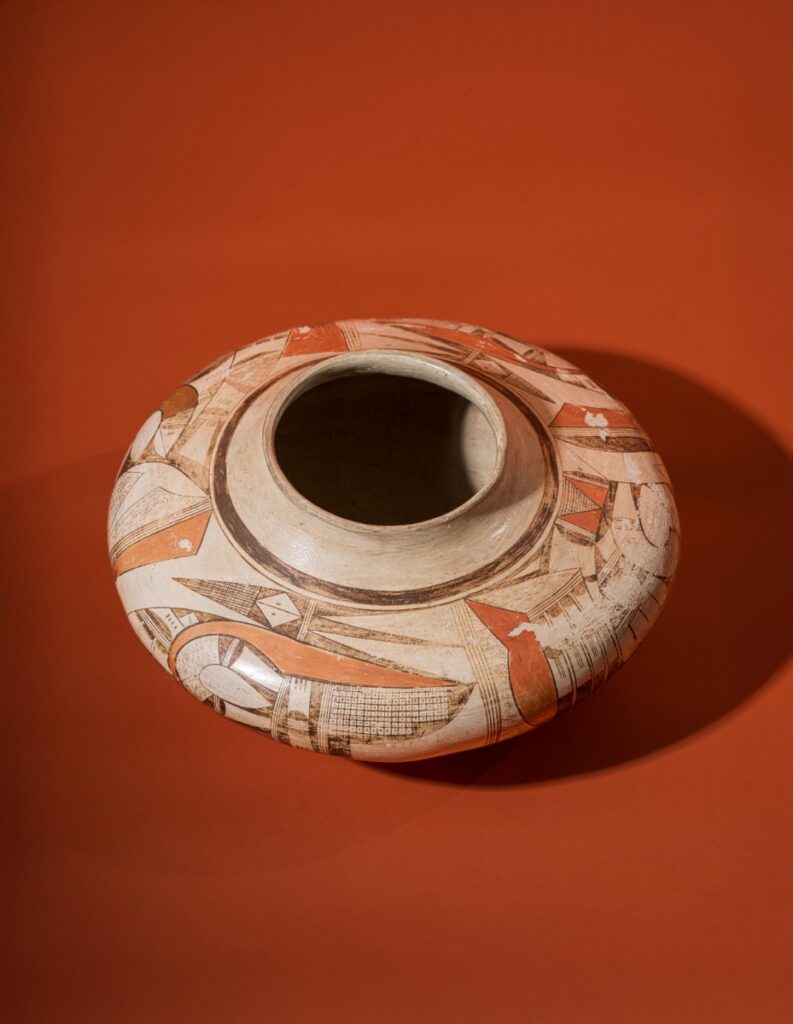
Michael chose three pieces of Nampeyo pottery, including this piece circa 1915. In addition, I think what I was really looking at was the time period in which these were created. Specifically, this was the late 1800s and, furthermore, the early 1900s. At the same time, I was also looking at the abstract quality of the line of the images. However, it is important to note that each one of these represents something.
And in that same time frame, artists like Wassily Kandinsky were creating works on another continent that were of very similar line and form, whereas they were exploring shape and composition. I think Nampeyo was doing the same thing, but also creating something that was very spiritual and talking about our culture within these vessels.
I come from a long line of Hopi pottery makers, beginning with Nampeyo. In addition, my photography practice is related a lot to climate change, and, moreover, to where our culture is rooted in a sense of place, as well as to what is happening to that environmentally.
Nanibaa Beck (Dine), 2018 Ronald and Susan Dubin Native Artist Fellow
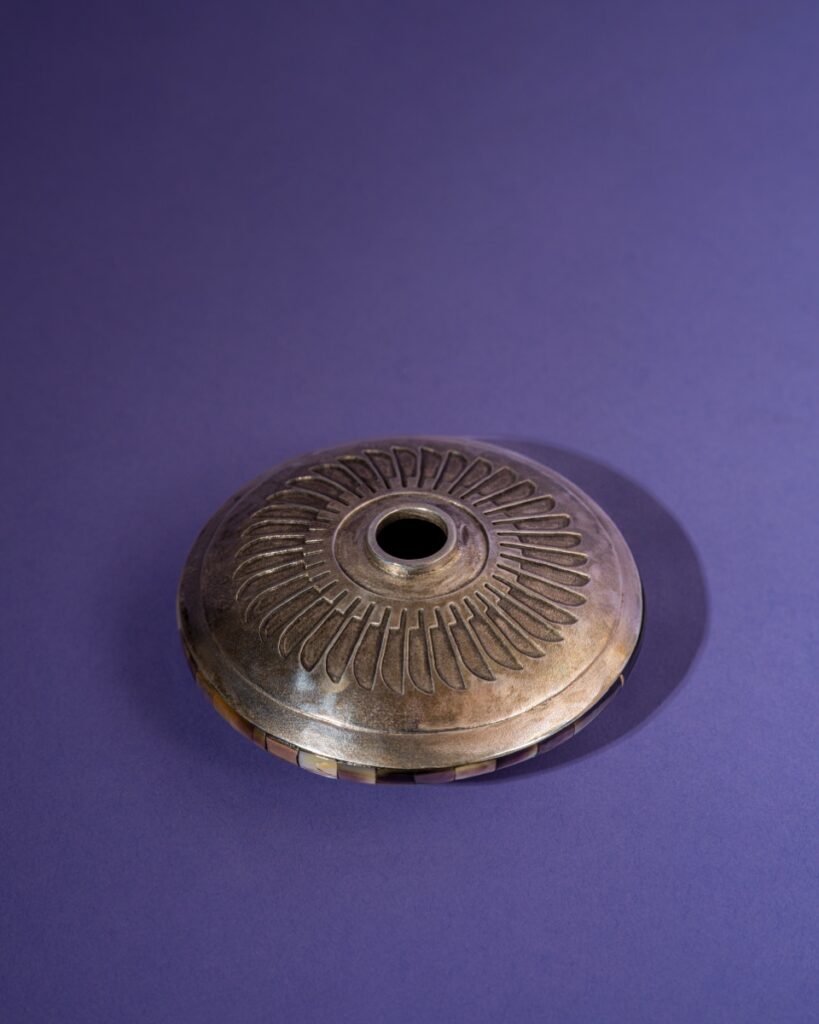
Connie was the first person next to my father who really gave me that sense of what artistry can be and what it is. She came into her own creativity in such an organic way that I would just lean into the way she spoke, the way she engaged with people, the way she welcomed me hanging around her and her family when I was just a kid.
It was from her that I got this sense of how you get to define how you want to be seen. It doesn’t always have to be defined in the terms of how your tribe designates you to be, because there are so many ways our creativity can bloom and grow. And she’s consistently been doing that in a way that also solidifies her within her tribe. I just love listening to her. I love talking with her, and I still do. She’s like my Santa Fe mom.
Ulysses Reid (Zia Pueblo), 2009 Ronald and Susan Dubin Native Artist Fellow
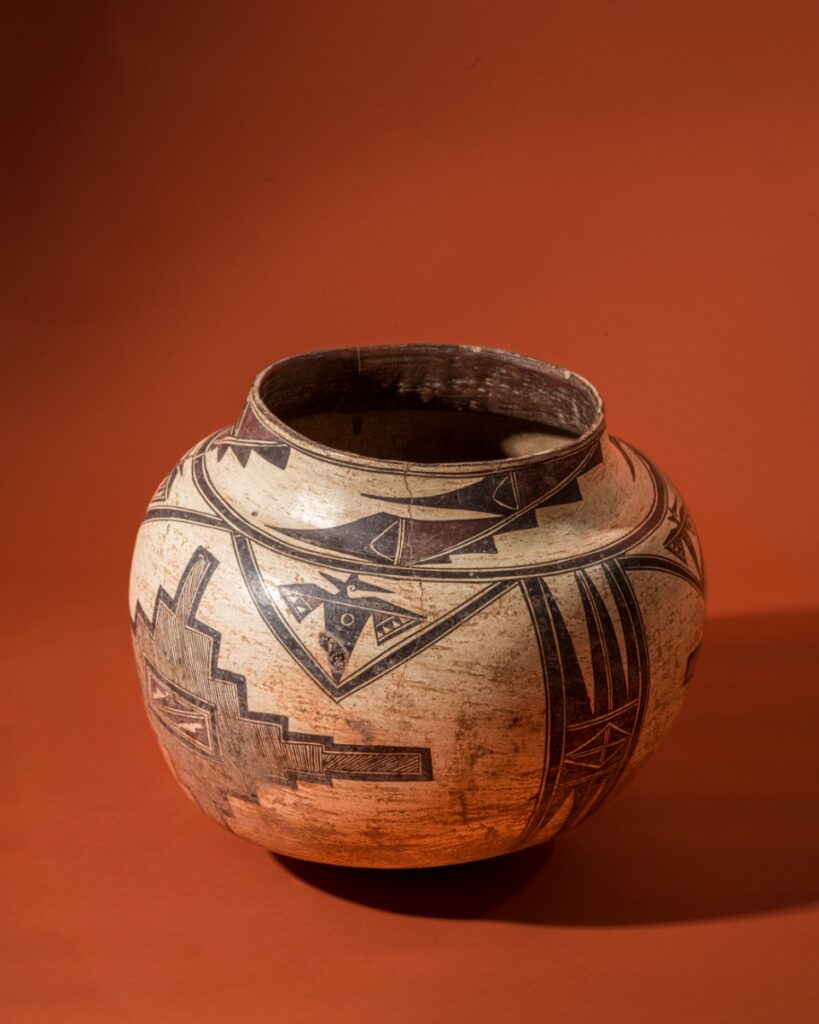
I really like art. So just from hanging out working in the museums, it turned me into an artist almost. The reason why I picked the Zuni piece is because it has a long history.
I can sort of see the line work and the detail and the overlap of how Zuni pieces from this period evolve into kind of those geometric pieces that you get out of Acoma, that I’ve seen out of Zia. It looks like stuff that you know, it’s almost universal. I think everybody somehow used that design on their own. It’s kind of like it moved around all the pueblos.
And I really like the whole part about the universal connections of how designs are used by other people. I like seeing how they are influenced by pottery made in other villages. When I really look at their designs, I also consider how my piece will work with that design.
Jonathan Loretto (Jemez and Cochiti Pueblos), 2012 Rollin and Mary Ella King Native Artist Fellow
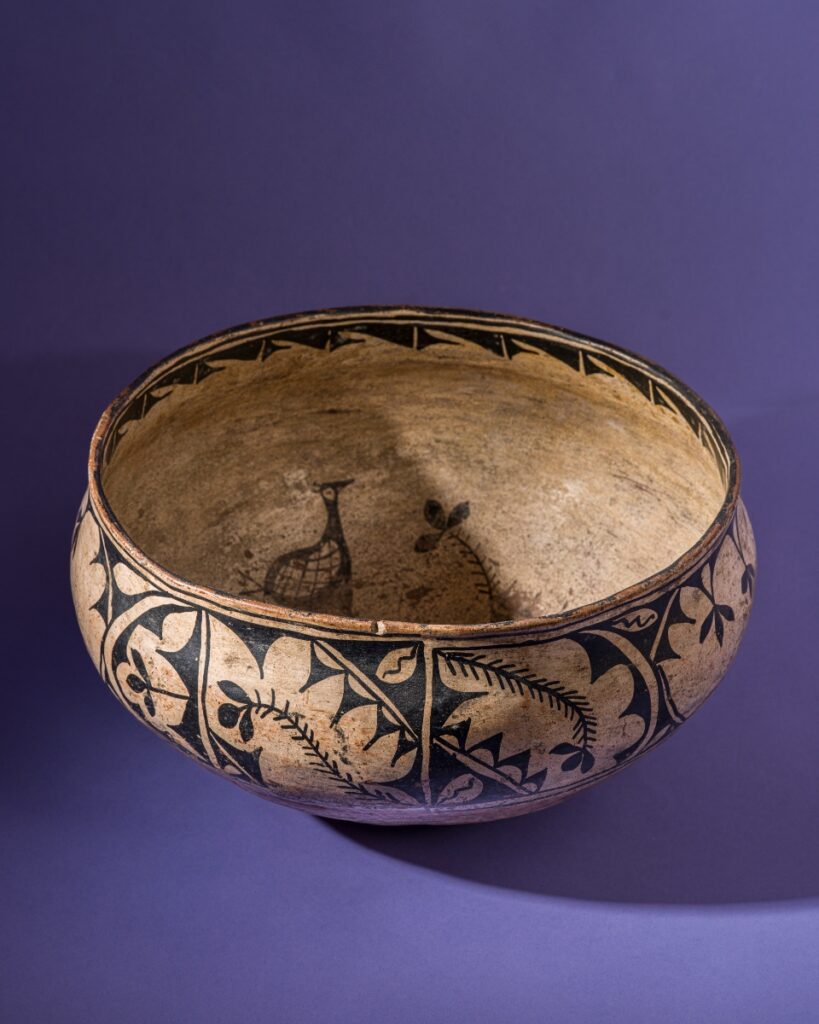
When you look inside you can see the wear that these were actually used – this vessel was actually storage for the food. Things that were happening at the time, you know, like what were they eating, what were the ingredients that they were using?
And it’s always something dear to my heart because I do love to cook. It kind of takes me back to when I grew up, going with my mom, aunties, or family. We would go pick wild spinach or onions. It brings you back to those memories, you know. We would just wait to see what your mom was going to cook with them. How she would use those ingredients in whatever she decided to make.
Also what I like about these pieces is they’re all fired outdoors and that’s what I do with my work as I keep it traditional as much as possible.
Leah Mata Fragua (Northern Chumash), 2020 Eric and Barbara Dobkin Native Artist Fellow
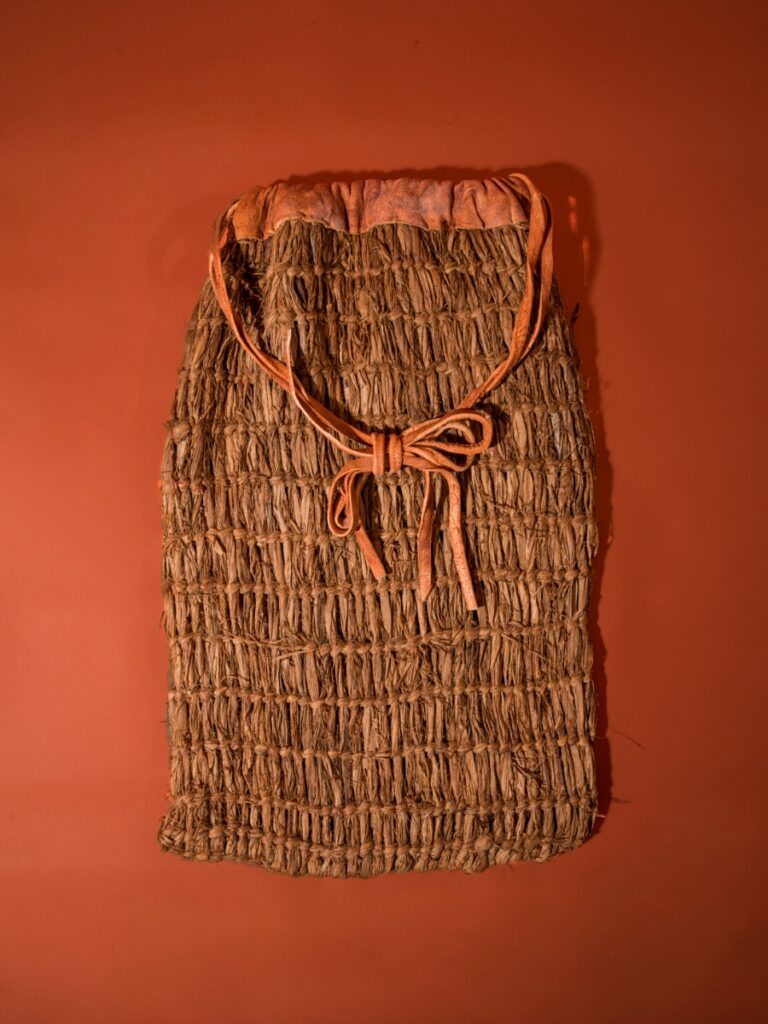
It was my first show and it was in Berkeley, California. And I was really nervous because I never had worked outside a community before and I wasn’t even sure like, how do you sell this stuff? How do you commodify it?
And so that was something I was struggling with. The maker of this particular basket was selling there. I was just amazed at their work and how well they navigated using more place-based or high craft work, and watched collectors come up, get excited, and line up to purchase works. I was thinking, “Wow, that’s so cool.”
And so, consequently, it really opened my eyes. Moreover, it really paved the way, at least for me, to think about how to move from just working within community spaces and, in addition, sharing my work within community, to, ultimately, moving it outside of community and, furthermore, moving it into art markets and gallery spaces.
Jason Garcia Okku Pin / Turtle Mountain (Santa Clara Pueblo), 2007 Ronald and Susan Dubin Native Artist Fellow
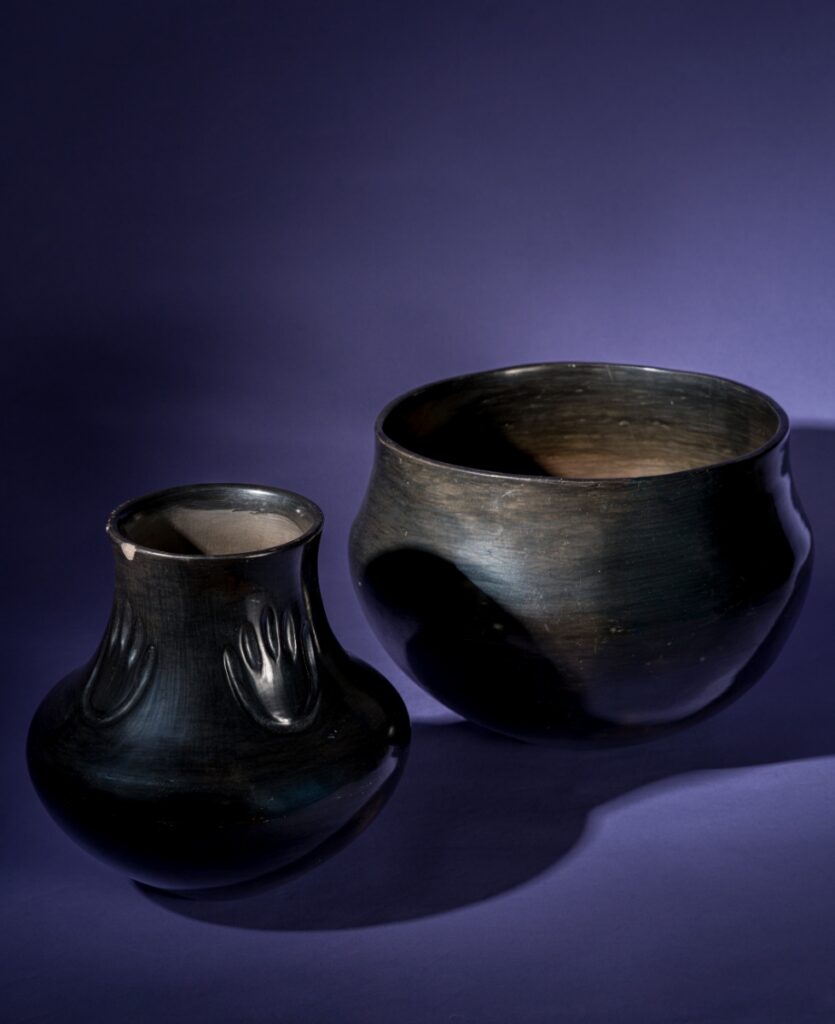
Severa Tafoya (Santa Clara Pueblo), water jar, before 1973, clay, 13 x 12 5/8 in. Gift of Judge and Mrs. Oliver (Jean) Seth, 1980. Collection of the
School for Advanced Research, Santa Fe, NM, catalog number SAR.1980-15-1.
It’s always amazing to look at these pieces and how the indentation is there. Usually when I see pots like this and others made by my paternal great-grandmother (Severa Tafoya), we’ll feel that indentation of where her finger made that impression of the bear paw.
It’s pretty smooth on the inside. But sometimes you’ll feel, on some of the pots, that indentation of a fingerprint. Then you know that you’re touching that person, in a sense. And sometimes, with pots like this, it’s amazing to see them. You pick them up, and the weight of them—it’s almost like holding a baby.
It’s always nice to see her work in the collection and kind of come in and revisit it and look at it, touch it, feel it, smell it, and just having that connection to her.
Nora Naranjo Morse (Santa Clara), 2000 Ronald and Susan Dubin Native Artist Fellow
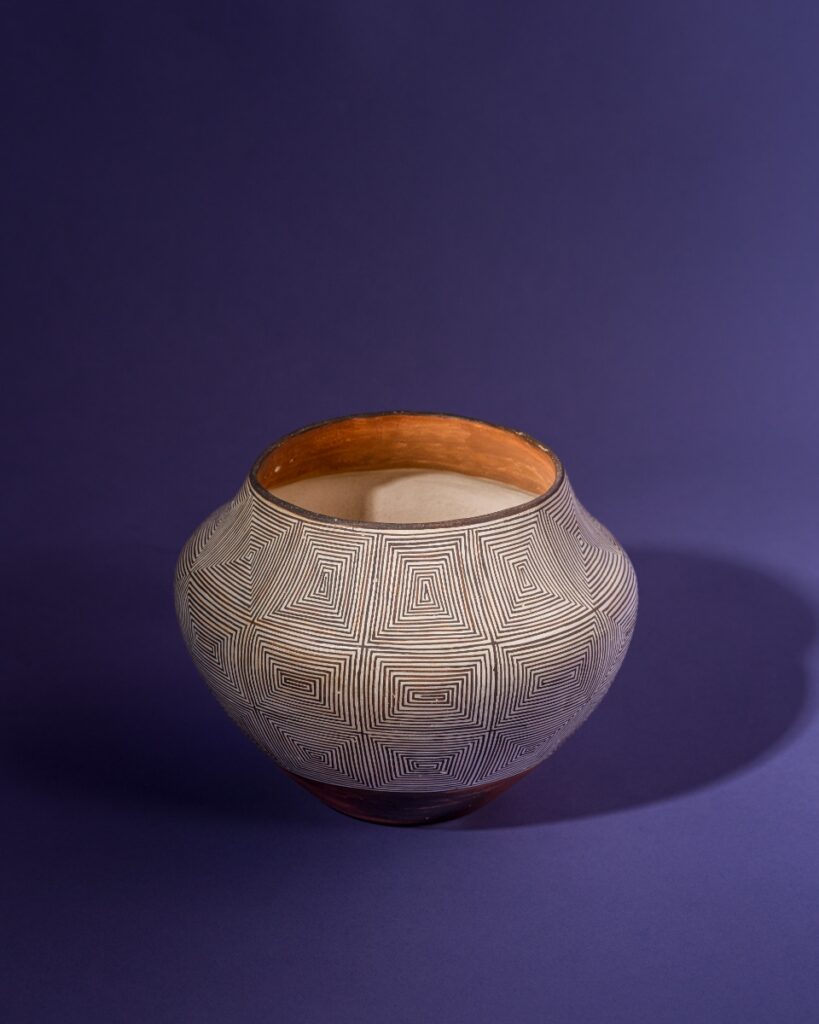
Lucy Lewis was born in 1889 in Acoma Pueblo and lived her life on what Acoma Pueblo residents call The Rock: a 365-foot-tall mesa that juts out of the ground in an otherwise flat landscape. Lewis most likely lived in the traditional village atop the mesa.
No electricity or running water — by today’s standards, a challenging lifestyle. However, Lucy’s creativity thrived. Her obvious drive and intentionality regarding her art motivate and inspire my own creativity. Lucy came from a long, rich history of pottery making, inherited from her mother and grandmother. I understand that familial connection to clay, I am also a part of that history.
Drawing inspiration from Mimbres and Anasazi pottery shards, she developed a strong sense of design. This design reflected ancestral creativity and the world she inhabited. Whenever I see Lucy’s work, I see a woman with vision. She has incredible skill—a pioneer who used her vessel’s surfaces like a canvas.
Story by TABLE Magazine Staff
Photography by Tira Howard
Subscribe to TABLE Magazine’s print edition.