In a bright studio space in midtown Santa Fe, tin artist Justin Gallegos Mayrant is hard at work on a commission from the Museum of International Folk Art prior to his booth at the Traditional Spanish Market, this year on July 24 and 25. A reinterpretation of a work from the museum’s collection, it features intricately painted pieces of coral red and deep green tin that are reminiscent of the petals on a squash blossom necklace.
It’s the kind of work people know Mayrant – work that combines the traditional Spanish art form of tinwork with a contemporary aesthetic. He’s been participating in the Traditional Spanish Market since he started working in tin when he was just eight years old.
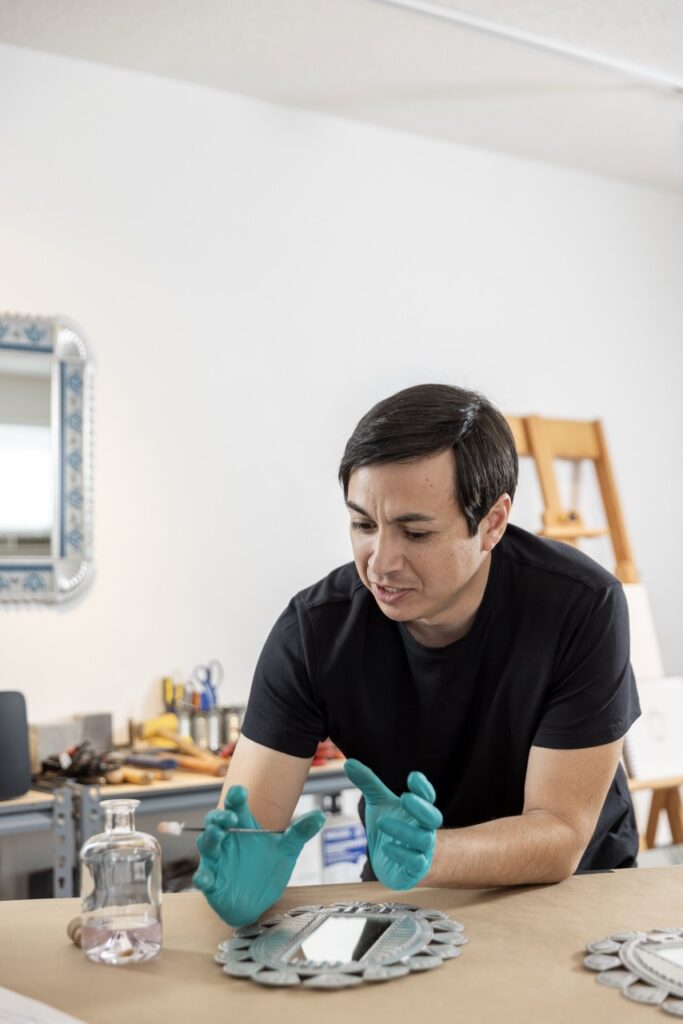
Justin Gallegos Myrant Brings His Tin Art Back to the 100th Traditional Spanish Market
“Spanish Market is focused on supporting traditional arts under the umbrella of Spanish colonial arts,” Mayrant says. “These are types of work that were developed starting from the 1700s through the 1920s,” he adds. These Spanish arts come from local materials, creating a new kind of artwork that exists only here in New Mexico.
The process for artists to show at Traditional Spanish Market is rigorous. They have to submit a piece to the jury of experts in the field. The process is anonymous, and even after they accept an artist into the market, they still have to resubmit work to the jury once every five years. “It’s the top level for this kind of work,” Mayrant says.
Mayrant is at a point in his career where he works primarily on commissions, like the one for the Museum of International Folk Art. Traditional Spanish Market gives him an opportunity to be creative as well as make pieces he’s been dreaming up. “With market, I get room to create the work I want to do,” he says, “all the original ideas that have been building up over the year.”
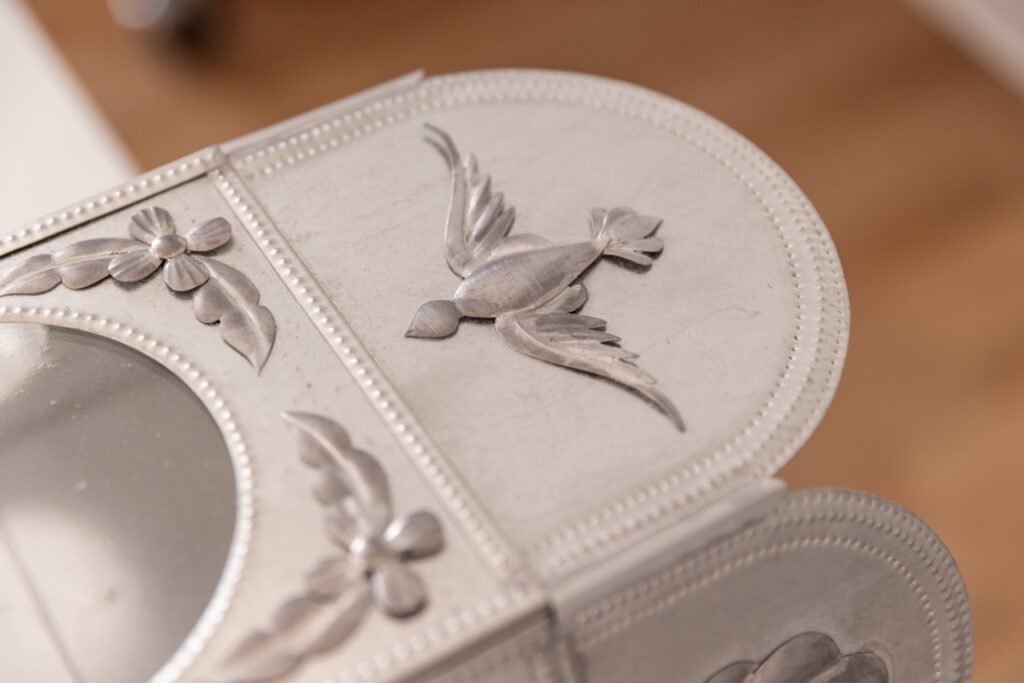
A Chance to Speak Face-to-Face at the Market
Meeting his collectors in person and also speaking about his art-form make Traditional Spanish Market an event Mayrant returns to year after year. “Getting the in-person experience at Spanish Market, people are able to get a much deeper understanding of the work, which I think is incredibly important.”
This year marks the 100th year of the market’s existence, which has had only a few brief hiatuses during World War II and COVID. “We want to keep our artists happy, and we find ways to enhance and improve the market for both our artists and attendees,” says Janette Salazar, cultural services manager at the Atrisco Companies, which has overseen the market for five years. “Some of our artists have been participating for 50 years.” Expect to see the work of 140 artists as well as around 20 youth artists at this year’s show.
Story by Maria Manuela
Photography by Gabriella Marks
Subscribe to TABLE Magazine‘s print edition.