Patrick Mehaffy is a self-described history junkie. He’s also an artist, writer, short film director, gardener, antique furniture buyer and restorer, furniture maker, and anthropologist. Blend all those nouns and you can understand why he has a 50-piece collection of coin silver cutlery.
Patrick Mehaffy Coin Silver Cutlery Collector
Speaking with Patrick comes with schooling—in a good way. We start with the early days of the American colonies, where there was no direct access to silver mines and limited access to raw silver resources. What you could find in circulation were foreign silver coins, rated at .900 purity, while British sterling silver was 925 parts per thousand. Though coveted as currency, colonists also began to melt and recast these coins into tools for daily life—cutlery, teapots, and candlesticks.
Just imagine silversmith Paul Revere’s advertising slogan. “Come hither with coins and go forth with forks!” How’s that for financial security? A kind of portable and utilitarian wealth that folks could use time and again. In a luster fight, the sterling silver would win, but who really cared when they could eat their mutton with a nice implement?
Where Does Coin Silver Cutlery Come From?
Fast forward to the mid-1800s. With the discovery of silver deposits in the American West, the practice of recasting coin silver into tableware began to slow. But the true death knell of coin silver was a combination of the Civil War, when fearing economic instability folks began to hoard coins, the rise of factory production, and a major push toward manufacturing an industry norm and sterling standard of .925.
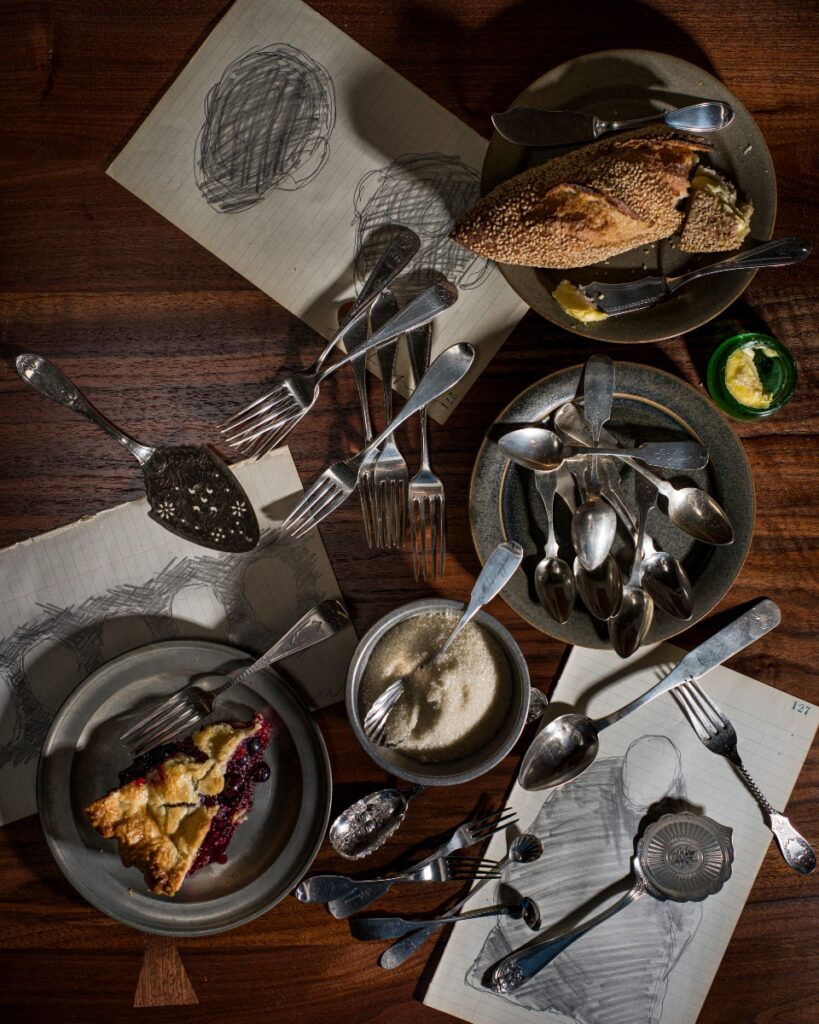
Today, you are likely enjoying your Cheerios with a stainless steel spoon. Patrick forgives you, though for him, it’s American coin silver all the way. “We use it all the time. It’s a beautiful lens for looking at history. I really like the idea of using something that people have used for the last 150 years. I like the pieces that are worn, that people have used.” He holds up a spoon with a distinctive and traceable (if you are intrepid) maker’s mark and says, “This was being used when Abraham Lincoln was alive. There’s a kind of continuity that I like.”
What’s So Special About American Coin Silver?
But were it not for friend and mentor antique dealer Vic Hansen, Patrick may never have begun this 40-year obsession with American coin silver. He lightened Vic’s load—once in suitcases stored in a basement—and unwittingly launched his current collection. “Since, I’ve just picked up pieces where I find them. Wherever I am, I am looking.”
Certainly, Patrick geeks out on all characteristics of any piece and we end up in a long discussion about how to read English hallmarks on sterling silver, the series of stamps involving the lion passant, the mark that indicates paying taxes, the city mark, the year indicated by a letter, which changes every 26 years, the maker’s initials, and so on.
But it’s the connection to our history and to the industrious, scrappy people we once were that means the most to him, “I just love it as kind of an expression of early America. These reflect an American economy, a Yankee economy.”
Intrigued? Don’t read this last sentence unless you are prepared to be hooked. Patrick says you can likely find a selection of American coin silver tableware at Stephen’s A Consignment Gallery should you want to start your own collection.
Check out more Santa Fe Collectors!
Story by Cullen Curtiss
Principal Photography by Tira Howard
Subscribe to TABLE Magazine’s print edition.